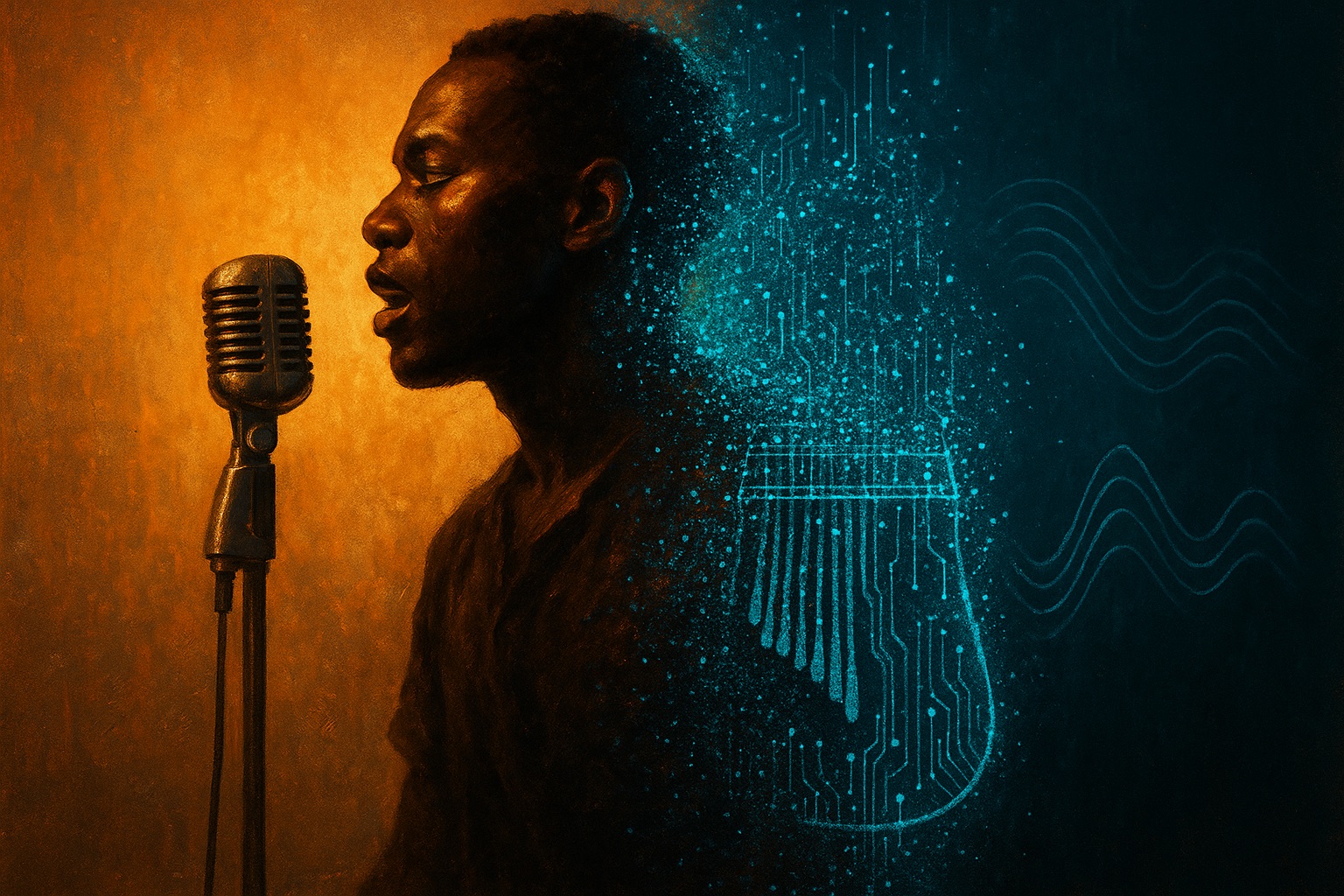
A while back on this blog I wrote a piece called the year the machine learned to sing Shona. I wrote it as a warning shot, the way you fire in the air to make people look up. I do not think it is a warning anymore. The machine is not coming. It is here, it is on the charts, and it did not wait for a single musician to give it permission.
Let me tell you what pushed me to write this. There is a gospel-style song going around, credited to artificial intelligence, that has crossed millions of views and is now playing in public spaces the way any real hit plays. There is an act going by the name Grace Wave, a voice with no body, no birthday, no mother, whose music has quietly become part of ordinary life. The Herald ran a piece calling it man versus machine, and then another one calling it the fight for Zimbabwe's music soul. When the national paper is talking about the soul of the thing, you are past the point of pretending it is a gimmick.
This Is Not a Zimbabwean Problem, It Is an African Moment
I want to be careful not to make this small. This is not a few weird uploads in Harare. Down in South Africa, artists as big as Cassper Nyovest and Vusi Nova have raised their voices about AI-generated music, because they can feel it moving toward their own front door. Up at Wits, there is a project that pulled artists and engineers from seven African countries, South Africa, Cameroon, the DRC, Ethiopia, Ghana, Kenya and Nigeria, into one room to work out how Africa should build with these tools instead of being built over by them. Tools like Suno have made it possible for a person with no studio, no engineer and no budget to type a sentence and receive a finished song. That sentence is the whole story. The barrier that kept most people out of music has just fallen down.
The Honest Part, Because I Will Not Pretend
Here is where a lot of artists want me to plant a flag and scream that the machine is evil. I am not going to do that, because it is not the whole truth. AI is a threat and an opportunity at the same time, and any musician who only sees one of those two things is going to get hurt by the one they ignored.
The threat is obvious. When a song costs nothing to make and takes ninety seconds to finish, the space floods. When the space floods, the value of any single human voice drops, because there is simply too much noise for the ear to sort. And a machine can now imitate a sound, a flow, a vocal tone, without paying the twenty years it took a real person to earn that sound.
But the opportunity is just as real, and I would be lying to you if I hid it. For a place like Zimbabwe, where most talented people never see the inside of a proper studio, these tools hand out access. Access to production. Access to reach. Access to the kind of market intelligence and visibility that used to belong only to the connected few. A kid in Budiriro with a phone can now build a full record. That is not nothing. That is the door a lot of us wished for.
Why I Am Not Afraid, and Why You Should Not Be Either
I make my living as a self-contained musician. I write, I produce, I sit in the mix. So you would think I have the most to fear from a machine that writes, produces and mixes for free. I do not, and here is why.
The machine can generate a sound. It cannot generate a life. It has never lost anyone. It has never left home and ached for it. It has never sat in a room in Cape Town chasing a feeling it cannot name until three in the morning. Every real record I have been part of carries something the machine has no access to, which is the specific weight of having lived the thing you are singing about. Kure Kure moves people because it remembers a war. A song about your late mother moves people because you had one and you lost her. The machine has neither the war nor the mother.
So the craft still wins. But, and this is the part I need you to hear, only if the craft refuses to be lazy. The artist who thinks the machine is a joke, and who therefore never learns the tools, is the artist who gets buried by the person who took them seriously. You do not beat the machine by pretending it is not there. You beat it by being so undeniably human that no imitation comes close, and by being smart enough to use the same tools for your own reach.
What Zimbabwe Should Actually Do
Not ban it. You cannot ban water once the dam has broken. Not panic either, because panic makes people do stupid things like ignore a whole generation of new creators.
Three things. Build our own, so African stories are told by African tools trained on African sound, which is exactly what that Wits project is reaching for. Protect our catalogues, because the old masters, the mbira lines, the chimurenga melodies, the sungura guitar, are training data now whether we like it or not, and a people who do not archive and defend their own sound will watch it get fed to a machine and sold back to them. And demand honesty, so that when a song is made by a machine, the listener is told, and the artist whose voice was copied is credited or paid.
The Last Word
The machine is already on the charts. It is in the kombi, it is in the church-adjacent playlist, it is in your child's phone. It did not ask any of us if it could come. That is the uncomfortable truth I keep landing on, and it is the reason I stopped calling this a warning.
So here is what I have decided, and I offer it to every real artist reading this. Do not wait for permission either. The machine is not going to hand it to you, and neither is the industry. Make something so alive that a copy of it feels hollow the moment it plays. That is still the one thing no machine has worked out how to steal. Go and out-human the machine. It is the only fight we are actually built to win.

Listen to Teemak
Afrobeat, Amapiano and Sungura guitar out of Harare. Start with the Mavambo EP or the Disemba single.